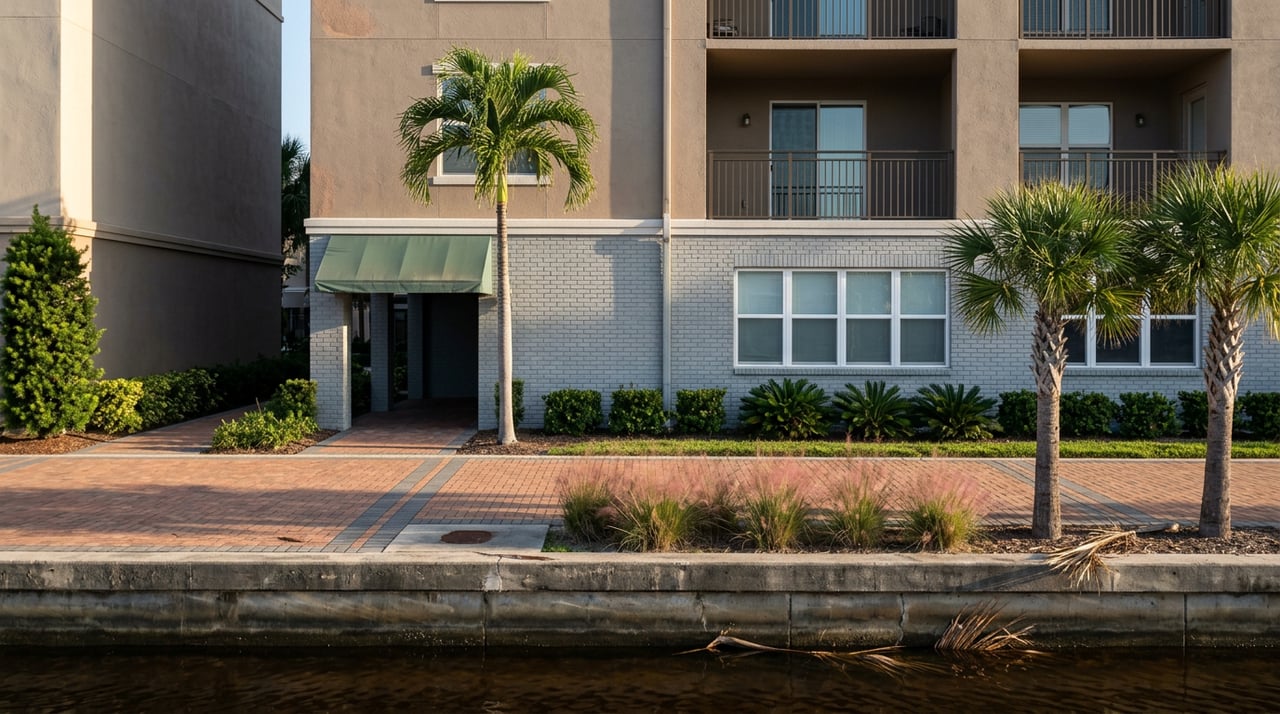
Walk the brick path along the Hillsborough River this August and you will find a stretch near the University of Tampa still fenced off, decorative brick bands half laid into fresh concrete, matching the pattern across the water at Plant Park. A few hundred feet downstream, the S.S. American Victory sits at its usual mooring, except now it carries a designation it didn't have in June. And a few blocks north, on a strip of Franklin Street that spent most of 2025 as a shuttered taco stand, a new sign went up in early July.
None of these three things belong to the same press release. That is the point. For two years, the story about downtown Tampa has been told the same way: cranes, master plans, towers rising one at a time, a neighborhood permanently described as "still filling in." That framing is starting to lag behind what is actually happening on the ground. The river's two sides are stitching themselves together through infrastructure connections and small storefronts landing weeks apart, not through the next headline tower breaking ground.
The Bridge Between Plant Park And Cass Street
The clearest evidence of that shift is underground work most residents haven't noticed yet. A nearly 2,000-foot segment of the West Riverwalk, running between Plant Park and Cass Street, is expected to open by the end of 2026, weather permitting, according to Tampa officials. The Haskell Co. is building the 12-foot-wide multiuse trail, and the design team deliberately matched the decorative brick bands to the University of Tampa's existing architecture and the brickwork already in Plant Park, so the new stretch reads as an extension of the old rather than a construction-era patch job.
That segment is one piece of the larger West River BUILD project, a nearly $60 million effort covering about two miles of new Riverwalk and roughly three miles of roadway improvements on the west bank. The funding stack includes a $24 million federal BUILD grant and a $10 million contribution from the West Tampa Community Redevelopment Agency, with the rest coming from the city's Community Investment Tax and future bonds. The practical result for anyone living on either bank: once this segment opens, a UT student, a Tampa Heights resident, and someone in a Channel District tower will all be able to walk the same continuous path without detouring onto a street. The full West River BUILD project is expected to wrap in spring 2027, but this particular link, the one connecting the university campus to downtown, is the piece scheduled to land first.
Three Storefronts, One Week
While that infrastructure work continues underground, the faster-moving story is at street level. In the first two weeks of July 2026 alone, three unrelated storefronts opened within walking distance of each other, each taking over a space that had sat empty or underused.
| Opened, July 2026 | Location | What It Replaced |
|---|---|---|
| Blind Tiger (coffee, breakfast, pastries) | Rivergate Tower | Moxies |
| Bodega Bus (chopped cheese, Mediterranean seasoning) | 505 N. Franklin St. | Taco Bus, closed 2025 |
| A new Greek stall | Sparkman Wharf | An empty shipping container as of the prior quarter |
Bodega Bus is a useful example of what "infill" actually looks like on the ground. The concept is owned by Khalil Mohammad, who worked in delis and corner stores in Buffalo before bringing a chopped-cheese sandwich, seasoned with a Mediterranean blend instead of the usual sazón, to a stretch of Franklin Street that hadn't had a late-night option in years. None of these three openings needed a new building. They needed an operator willing to take a space that already existed and make it work again.
The same logic shows up a few blocks south at Water Street, where a new restaurant called La Victoria is aimed at office workers, neighborhood residents, and the convention crowd rather than tourists passing through. The owner told a local business outlet the goal was to bring some personality to the district, which reads less like a chain rollout and more like someone betting that the neighborhood now has enough regulars to support a room built around them rather than around visitors.
A Ship Becomes A Landmark
The least commercial addition to the Riverwalk this summer is also the hardest to miss. On July 1, 2026, the S.S. American Victory officially became Florida's state flagship, following Governor Ron DeSantis's signing of HB 249. The World War II-era vessel, permanently docked downtown at the foot of the Riverwalk, is one of only three fully operational Victory-class steamships left in the world.
That designation doesn't add a restaurant or a retail tenant to the strip. What it does is give the Riverwalk a fixed cultural anchor that isn't tied to any developer's leasing timeline. Towers get built and storefronts turn over, but a state-designated flagship permanently moored at the same spot is the kind of landmark a neighborhood can point to for decades. It sits at the corner of the same walking path that will eventually run unbroken from Plant Park to the west bank, which means the anchor and the connective tissue are arriving on roughly the same timeline.
West Tampa Isn't Waiting Either
The west side of the river has its own version of this story, and it predates this summer's headlines. Julian B. Lane Riverfront Park reopened in 2018 after a $35 million reconstruction, and it has spent the years since becoming the anchor for redevelopment around it. The Tampa Bay Sun, the city's USL Super League soccer club, invested millions to renovate Riverfront Stadium at Blake High School into its current home ground. A few blocks over, Salcines Park began a $1.4 million renovation earlier this year.
City Council member Guido Maniscalco, whose district includes this stretch, has pointed to an old mural in Salcines Park that once read "It's time for West Tampa" as a kind of standing prediction.
"Well, it's time for West Tampa," Maniscalco says.
Joe Robinson, who chairs the West Tampa Community Redevelopment Area's Citizens Advisory Committee, frames the Riverwalk extension as more than a recreational amenity. He describes it as a project that will connect West Tampa to downtown and East Tampa, give residents a safer route to work and school, open public access to the riverfront, and give small businesses in the area a boost.
None of these projects are new announcements. They're the accumulated groundwork that makes this summer's storefront openings and the Riverwalk's coming connection make sense as a pattern rather than a coincidence. The west bank has been laying infrastructure and civic investment for years. The east bank's small businesses are now filling in around it.
What This Adds Up To
Put the pieces next to each other and the shape becomes clear. A resident walking this corridor a year ago saw a construction zone with a distant finish line. A resident walking it this fall sees a coffee counter that wasn't there in May, a sandwich shop with a new owner's name on the lease, a state flagship with fresh signage, and a brick path under construction that will, by the city's own timeline, connect two neighborhoods that have spent years developing on separate schedules.
That is a different story than "downtown Tampa is still filling in." It's a neighborhood assembling itself in smaller, faster increments, on both banks of the same river, at the same time. For anyone who already lives along this stretch, whether in a Water Street tower, a Tampa Heights bungalow, or a West Tampa block near Julian B. Lane Park, the practical takeaway is simple: the walking radius around your front door just got a little wider, and it will keep widening through the end of this year without another tower needing to top out first.
If watching this corridor change has you thinking about what your own address is actually worth in a market that's quietly rewriting itself block by block, The Brescia Group tracks these shifts across Tampa Bay as they happen. Get Your Instant Home Valuation and see where your property stands today.